
3.1. Chapter
In the first chapter we described blockchain as a network which maintains the blockchain data structure. In this chapter we will explore this network and understand how its participants coordinate to keep the blockchain data structure valid.
As a refresher the network is composed of potentially millions of computers, called nodes. Nodes are responsible for storing, adding to and verified the blockchain data structure and as we will see they come in many flavours. Nodes are often connected to each other in a random combination forming a web of connections that is the distributed system of blockchain. This web is responsible for transporting any and all information on/about the blockchain.
3.1.1. Nodes
Nodes are the basic building block of networks. Nodes are devices that connect with other devices to share data the network cares about, in our case BADS. This is a vague definition and that is because there are different types of nodes:
‘Full’ Nodes - Nodes that store the entire blockchain and can verify all data independently and produce blocks. When we just say ‘nodes’ we typically mean full nodes.
‘Light’ Nodes - Nodes that only store the block headers and need the help of full nodes to verify data. Typically, don’t produce blocks. When we talk about light nodes we will explicitly mention they are light nodes.
‘Light’ Nodes are a solution to the fact that some network participants can’t store the whole blockchain. The benefit of light nodes is that they can still verify incoming data, a useful feature for nodes that want to host wallets in currency blockchains like Bitcoin. They do this as follows:
They send a connected full node the hash of the data they want to verify
The full node locates the block the data is in and sends a merkle path to the light node
The light node uses the merkle path to construct a merkle root and if it matches the root in its block header the data is valid as it is in the blockchain.
Note
Merkle Paths are an efficient solution to proving whether a piece of data is in a merkle tree. Rather than use all the data and let the light node construct the merkle root from scratch we only need the hashes of the nodes that come into contact with the path from the root to the piece of data we want. This means that we only need to send a couple of hashes rather than the whole merkle tree. This helps efficiency.
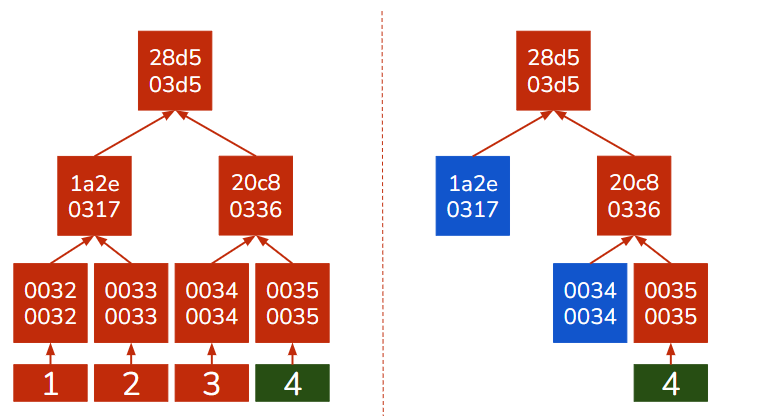 If we want to verify that 4 is in our merkle tree we don’t need the
whole merkle tree to do it. Assuming we know what the root is
supposed to be we only need the hashes highlighted in blue and we can
calculate the rest, shown in red.
If we want to verify that 4 is in our merkle tree we don’t need the
whole merkle tree to do it. Assuming we know what the root is
supposed to be we only need the hashes highlighted in blue and we can
calculate the rest, shown in red.
3.1.1.1. Node Gossip
In a distributed system and network like Bitcoin there is no authority to manage connections so nodes have to manage them on their own. Node communication is often analogized to gossiping.
Nodes often store a ‘contact list’ of connected nodes and they often ‘ping’ their contacts to check if they are new. If a new node arrives nodes share their contact lists so the node can quickly connect with others. Nodes typically have multiple connections, between 4-5, to make sure any connected node going offline or turning out to be malicious doesn’t severely impact the node.
Nodes therefore form a disorganized connection network where they gossip information about the blockchain. Nodes can come and leave as they wish without affecting the network at-large. This greatly adds to the stability of the network.
Tip
Nodes leaving and going as they please is one of the benefits of distributed networks vs centralized ones. If the ‘leader’ node leaves in a centralized network that network stops functioning.
The gossip network is also optimized against malicious data. Nodes don’t blindly relay data they receive as that could clog up the network with useless or malicious data. Every time a node receives a piece of data or block it verifies it. If the data/block is valid and is new, the node hasn’t seen it, the node stores it and sends it to the nodes in its connection list. If the data/block is invalid the node discards it, sends it to no one, and potentially removes the node who sent it that data from its contact list.
Information propagates through the network from node to node and because one node sends it to multiple nodes the spread is exponential. This means that data, if valid, propagates through the entire disorganized network in a matter of seconds while invalid data is stopped at the first nodes that receive it. The origin of data is not shared so when a node receives data/block it doesn’t know where it originally came from.
Nodes technically have no responsibility to do anything, propagate data or generate blocks. Many nodes don’t generate blocks. Full nodes that do, store data that is valid but not in a block yet in a special area called a mem pool, in the case of Bitcoin. When nodes create new blocks the data they contain comes from the mem pool. If a node receives or generates a valid block the data it contains is removed from its mem pool.
3.1.1.2. Node On-boarding
We mentioned that nodes can come and leave as they please. This means nodes go out of sync with the rest of the network and their blockchain is incomplete, or non-existent when it’s a completely new nodes. A node that is completely new to the network does the following:
You start with the most recent trusted block, the newest block you trust to be valid. For new nodes this block is the genesis block that is hard-coded in the blockchain implementation.
Reach out to other nodes in the network, as you connect with nodes you receive their contact lists and reach out to even more nodes.
You ask your connections for all the blockchain data & blocks they have.
You verify the data/block and if it references your most recent trusted block you add to your own blockchain. If it doesn’t reference that block but is otherwise valid you keep hold on to it, it’s possible that you received a valid block before you got some of its predecessors.
Repeat step 3 & 4 until your most recent trusted block is also the blockchains most recent block, this can take a couple of days.
Tip
We occasionally use the word hard-coded. This means that this piece of data is a part of the implementation and anyone who has the implementation automatically has the data.
For a light node the process is simpler and faster as you only receive the block headers which can be quickly verified, do they reference the most recent trusted block header and do they meet the blockchain’s block validation guidelines.
3.1.2. Consensus
Formally consensus is when a network reaches the same conclusion. For the blockchain the same conclusion means the same BADS. Consensus guarantees Blockchain’s ‘identicalness-as-a-requirement’. Consensus is a fascinating subject because it is a process that happens independently at every node but the result is always the same.
Consensus determines what a valid block is and guarantees that it is added to every node’s blockchain.
Consensus can be achieved through a number of consensus algorithms. We will be looking at the two of the more famous algorithms: Proof-of-Work and Proof-of-Stake.
3.1.2.1. PoW
Proof-of-Work (PoW) is a consensus algorithm that depends on hashing. Its primary component is the hash puzzle which is composed of a target value that the block header’s hash has to be smaller than the for the block to be valid. Getting such the desired block header hash is done by altering the nonce, a field in the block header, and is intentionally difficult to solve. A value called the difficulty determines how low the target is, difficulty and the target value are inversely correlated so a higher difficulty means a lower target. To keep the ABCT (Average Block Creation Time) constant the difficulty is regularly updated.
PoW is a competition between nodes for who solves the hash puzzle, gets a block header whose value is smaller than the target. Blockchains typically reward the node that wins this competition. This means nodes are incentivized to try to solve the hash puzzle and when someone claims victory, to critically analyze their winning block, as no node wants to lose a potential reward to a cheat.
To win PoW nodes can only do one-thing, guess. There is no clever way to solve the hash puzzle, nodes just have to guess a million numbers and check if any of them get the desired block header. This means millions upon millions of calculations, most of which will go to waste. This is incredibly inefficient and PoW has been criticized for being so wasteful.
PoW also shifts the definition of an honest majority in a blockchain. In this consensus algorithm an honest majority is an honest majority of computing power. This one-cpu one vote ideology has the shortcomings that it benefits richer miners with better equipment.
Difficulty is also used to determine what chain is the valid one. In PoW we might have malicious actors trying to push their fraudulent chain of the blockchain to be the valid one. To prevent this, PoW defines the valid chain as the one with the most cumulative difficulty. The reasoning is that if we have an honest majority of computing power then it will be able to produce the most blocks with the greatest difficulty and therefore always be ahead of any attackers.
Note
When we talk about chains we talk about a sequence of blocks pointing to each other. These chains might share some nodes, all share the genesis block, but disagree on others. In PoW we might have multiple competing chains at the same time due to forking, which we will cover shortly, or because of malicous actors trying to push a fraudulent blocks.
3.1.2.2. PoS
Proof-of-Stake (PoS) is a consensus mechanism where nodes can only propose and validate blocks if they stake the blockchains native token, if it has one. By staking we mean that the node stores the blockchains token for a given period of time without moving it. These tokens are staked to act as collateral against malicious behaviour, if a node produces a block with invalid data or validates a block like that is loses some of its tokens, this is known as slashing. Nodes can have two roles in a PoS system: producers (responsible for actually producing the block) or validators (responsible for checking the block is valid).
PoS is alot more diverse in its implementations than PoW. In some implementations, like PeerCoin, nodes become eligible to produce blocks as soon as they stake their currency for a period of time, for PeerCoin 30 days, while others, like Ethereum 2.0, it is a more organized process.
In Ethereum 2.0 the process is more structured and nodes need to stake at least a set number of tokens, in Ethereum 32 Ether, to be considered to produce the next block. The actual producer of the block is chosen pseudo-randomly by the blocks and while the other staked nodes become validators and are put into committees. Before a block is validated it needs to pass a number of these committees and any malicious behaviour, either on the side of the validator or producer, is strictly punished.
Note
The last paragraph might be a bit confusing. Pseudo-random: didn’t we say that bad? Yes and no. It’s bad when used for cryptography but here we are only deciding which node gets to produce the next block. We are also doing so based on data about the blockchain that is produced unpredictably, so pseudo-random is fine here. This might seem like a very unsatisfying answer and that is because the actual process of producing the same pseudo-random number at every node independently is an incredibly difficult thing to do. On Ethereum it is done by something called the Beacon Chain and RANDAO, both programs, which also decide which nodes are the producer and validator. Discussion of these two in any sort of depth is far beyond the scope of this textbook.
PoS defines an honest majority as a majority of the staked tokens. The rationale behind this is that even when a malicous party has a majority of the staked tokens they wouldn’t want to undermine the blockchain they are so heavily invested with. Valid chains are determined either still by difficulty, through a simplified hash puzzle that has to be solved on top of PoS, or determined by programs like the Beacon Chain in Ethereum 2.0 . But in general, the number of chains in PoS is greatly reduced so determining the valid chain is alot less complicated, and we pay it less mind.
PoS blockchains still reward producers and some, like Ethereum 2.0, also reward validators. This makes them a more reliable source of tokens than PoW that is just a winner-take-all competition.
Tip
This reliability is the primary driver of the popularity of staking. Where cryptocurrency holders stake their tokens in reward for interest.
The benefits of PoS is that blocks are produced relatively easily, you just collect a set of valid data and produce a block around it. This means there is far less processing waste than with PoW as there is no hash puzzle to solve, or it’s very simple to solve like in the case of PeerCoin.
While it may seem like inadvertent centralization to put a single node in charge of producing a block PoS blockchains heavily regulate this. First the node is given a set amount of time to produce the block and if it doesn’t the node is punished and another node fills its place. The produced block is also rigorously checked so one node will never be the point of failure for a PoS blockchain.
3.1.2.3. PoW v PoS
Proof-of-Work was the first consensus algorithm used on the blockchain through Bitcoin while Proof-of-Stake started showing up a couple years later. In many ways PoS was created to address the shortcoming of PoW but both consensus algorithms have their pros and cons.
Algorithm |
Pros |
Cons |
|---|---|---|
PoW |
Is battle-tested and more reliable than PoS |
Very inefficient by design |
PoS |
More efficient and doesn’t benefit better equipped miners |
Higher cost of entry than PoW, you have to stake tokens to participate |
Tip
The benefit of PoW might seem strange. Why would we care that PoW has more real-world experience when it is less efficient? The answer is that for some projects, like rockets, reliability is far more important than efficiency. This is the reason why the latest rockets use processor older than anything you could currently buy.
3.1.3. Maintaining the Network
We have covered how a blockchain network ought to run to maintain BADS but we still need to figure out how to maintain it. We need to address how are accidents/mistakes solved and who actually partakes in block production/validation.
3.1.3.1. Forking
3.1.3.1.1. Accidental Forking
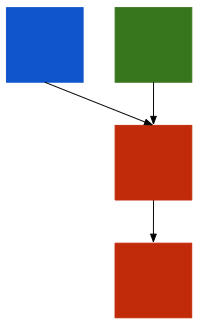
We called PoW a competition, but what happens when we get a tie? When two nodes produce two valid blocks at the same time and propagate it through the network we will have a split. Some nodes will have a different blockchain from the rest following the very consensus algorithm that was supposed to prevent this. What do we do?
First we must mention that accidental forking is rare, this does not happen every time a block is produced, so we are dealing with an infrequent situation. When this happens the blockchain has two valid chains, as the difficulty should be the same. This is called forking. Nodes can and do detect it and store both chains but work on a block that only goes on top of one of them, as linked-list nodes can only point to one other node. This means that when the next block is produced it will only reference one chain and then the cumulative difficulty definition of a PoW chain kicks in. The chain that the new block references becomes the valid chain and the other is discarded.
Tip
It is theoretically possible that two blocks are produced at the same time when there is already a fork. This is very unlikely and even if it happens we just wait until only one block is produced and then apply the above.
3.1.3.1.2. Intentional Fork
The above happens accidentally. We don’t want two chains, but it happens by chance, and we can’t predict. This happens when the blockchain implementation changes rules and nodes are divided by whether they follow the new ones or not. There are two types:
Soft Fork - The rule changes are such that even nodes that don’t follow them can add valid blocks under the new rules (i.e. increases the block size).
Hard Fork - The rule changes are such that nodes that don’t follow them cannot add valid blocks under the new rules (i.e. change data validation).
While both can produce two chains (forks) the latter is far more likely to do so and two chains can continue to exist for a very long-time, this is in contrast to accidental forks where two chains exist only temporarily. Forks can cause the creation of new blockchain projects (Bitcoin and Bitcoin Cash).
3.1.3.2. Miners
Nodes don’t have to create blocks. But it is critically important to a blockchain that blocks are regularly produced as if they aren’t a malicious chain might become the valid chain. Blockchains therefore need an honest class of nodes to create blocks, these nodes are called miners.
Miners are the nodes that create blocks, and they appear in many consensus algorithms. In PoW they are the nodes that participate in the competition to solve the hash puzzle. In PoS they are the producers and validators that create & validate blocks. Regardless of consensus algorithm, being a miner is extra work. To cover the costs of this extra work, blockchains give incentives.
3.1.3.2.1. Incentives
These incentives are often native to the blockchain. This means the reward is given through the blockchain. In currency blockchains, like Bitcoin and Ethereum, this is relatively simple as their native tokens are valuable, so they just reward them with that. Blockchains that don’t have a currency token have a harder time finding an incentive, but this doesn’t mean they are any less secure.
Note
The incentives in currency blockchains are typically issued per block. Each block has something known as a coinbase transaction. A coinbase transaction is unique in that is the only piece of data in a block that does not have to be proven correct by data in previous blocks. It is very much creating money out of thin air. The coinbase transaction is a composite of a block reward, the money out of thin air, and the transaction fees paid by participants as an incentive to include their transaction in the block.
The incentives worked. In blockchain projects like Bitcoin or Ethereum, the competition to solve the hash puzzle is very intense. In PoW blockchains , tens of thousands of miners competing for one prize the technology they use to solve the hash puzzle has evolved rapidly.In the early days of Blockchain even computer CPUs, processors, were good enough. Miners then moved on to GPUs, which are very good at doing ‘easy’ tasks like producing hash values and graphics, and then ASICs.
Application-Specific-Integrated-Circuits are special pieces of hardware made for just one use case, in PoW blockchains its to solve the hash puzzles. ASICs are very specific, there isn’t even a general PoW blockchain ASIC, and very fast. As of 2022, top of the line ASICs can do 100 TerraHashes per second which means it can produce 100 trillion hashes per second.
Tip
ASICs are not only used by Blockchain. If you know your logic gates you can even make an ASIC for your own uses! But be sure to remember that ASICS are only good at doing one particular task very well, anything else, and they’re pretty useless.
Bitcoin is a ASIC-optimal which means ASICs are the most efficient hardware to use when solving the hash puzzle. Because of this reason a majority of processing power in Bitcoin comes from ASICs. Other blockchain projects can be GPU or even CPU-optimal.
Note
ASICs are somewhat controversial in the blockchain space. This is because they are an excellent example of how better equipped miners can take over the network. For this reason some blockchain implementations, like Litecoin, have a hash puzzle that is intentionally difficult to solve on ASICs so miners use more common equipment like GPUs or even CPUs.
PoS is a bit more organized and the need for specialized hardware is lesser. To participate miners need to put up collateral, or stake, a typically not-insignificant amount of tokens. These staked tokens are still the miners, but they can be taken away if they act dishonestly either as a validator or producer. Miners also typically earn a more stable reward than in PoW because both validators and producers are rewarded, there is no incentive for validating in PoW.
3.1.3.2.2. Types of Miners
With different blockchains and changing circumstances comes the need for different types of miners.
Mining Pools are a reaction to PoW mining becoming increasingly competitive. At this point no individual miner has enough computing power to regularly win the hash puzzle competition. This means that individual miners run the risk of never getting a reward for the resources they spend trying to win. To address this, miners pool their resources together to stand a greater chance of winning and their miners get more stable, but smaller, rewards. Mining pools come in two types:

Centralized Mining Pool - Traditional mining pools where miners coordinate with a ‘leader’ node that relays information about the hash puzzle, publishes the winning block and distributes the rewards by processing power. These kinds of mining pools are straightforward to set up and can be managed easily, so they are a popular, but they are a point of centralization.
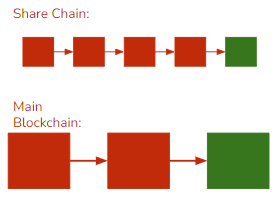
Peer-to-Peer Mining Pool - Centralized mining pools slightly defeat the point of blockchain being centralized so as a reaction p2p mining pools came to existence. Peer-to-Peer mining pools operate on a share-chain that is identical to the main blockchain and even includes & verifies the same data, but it has a lower difficulty and smaller ABCT. With a smaller difficulty and more regular blocks we can accurately gauge how much processing power each participant has by the number of blocks they add over a period of time, typically two weeks. These block additions are recorded in the coinbase transaction for that period of time and by the law of probability, even with a lower difficulty, one of the hash values will eventually be low enough to even meet the main blockchain’s target. When this happens the block is added to the main chain and all the miners that added a block on the share-chain in the past 2 weeks are rewarded.
Staking Pools address the high cost of entry in staking PoS blockchains. In staking pools miners pool their tokens to have enough to meet the typically high staking amount requirement. Larger pools are again responsible for more of the block production as a larger stake means they are more likely to be selected as block producers.
3.1.4. Types of Blockchain
Up until now we were talking about one type of blockchain, a public blockchain. This type of blockchain is the most well-known type, and we will devote a majority of textbook to discussing it. But while blockchains are attractive to anonymous communities, in part because they solve BGP, but they also offer potential for private networks where participants know and trust each other. This is because:
Blockchain is a reliable data storage medium because it is unlikely to crash or be erased.
Blockchain tracks every process on its network meticulously.
Blockchain is designed to only contain valid data.
Blockchain has many use-cases which therefore require different types.
3.1.4.1. Public Blockchain
Is what we think of when we think blockchain. There are no gatekeepers. Anyone can join, read and propose new blocks to the blockchain. This type of blockchain is completely decentralized and practices self-governance. This was the first type of blockchain and is the one used by some of the most notable projects like Bitcoin or Ethereum. Communities with anonymous participants or participants that don’t trust each other use this type of blockchain.
3.1.4.2. Private Blockchain
This blockchain selectively chooses its participants. Figures with authority determine who can join the network and with what amount of responsibilities (i.e. can they read or write or both). This type of blockchain is closed and is selectively distributed. This type is ideal for companies that want to use the blockchain to store sensitive data that shouldn’t be publicized. These blockchains can have more lax consensus and data validation algorithms because it is assumed the participants trust each other.
3.1.4.3. Public v Private
As with all things, different types of blockchain have their advantages and disadvantages. There is no type that is generally better than the rest, they all serve their independent use-cases.
Public Blockchain |
Private Blockchain |
|---|---|
Characteristics: |
Characteristics: |
Pros: |
Pros: |
Cons: |
Cons: |
3.1.4.4. Permissioned Blockchain
Trying to combine the best of both worlds, permissioned blockchains are a hybrid between public and private. Participants are selectively added but have rights as predetermined by some standard rather than being given them on a case-to-case basis. Typically, participants get all the rights they would in a public chain. This blockchain is selectively permissioned/restricted and is ideal for use-cases where participant trust is the central issue.
3.1.5. Byzantium
We now have the last piece of the puzzle, the coordination. The Byzantine’s General Problem illustrates the difficulties of coordinating a group of trustless, possibly malicious, participants through a siege. We have a number of generals which have circled the city of Byzantium and need to all attack at once if they are to succeed. The problem is that they have no reliable communication channels to talk through and some generals might be traitors that will intentionally try to push false information.
Blockchain offers a solution. By using BADS as the format of their messages they allow only valid messages to be taken seriously. With good cryptography they prevent anyone but the generals from creating messages and through networks and consensus algorithms they can efficiently spread valid messages, stop lies in their tracks and have a valid chain of messages even if only a small majority of generals are honest, the others are traitors. Generals need to trust no one but themselves and the system. They keep a record of all the messages and ultimately decide on their own whether they trust something.
The generals can now coordinate effectively and there is nothing Byzantium can do.
3.1.6. Conclusion
This chapter concludes the basics. If you only wanted to know the basic building blocks of a blockchain congratulations, you now do. The next part of the textbook will take what we learned and apply it to actual blockchain implementations. Up to now we were largely in the idealistic theoretical realm but as you will see in the coming chapters implementation is not always clean.